
Game Arts Program
Master game design and development in a supportive environment
The Exceptional Minds Game Arts Program is designed to prepare students on the autism spectrum for careers as game artists and designers across a range of production environments, including large studios, small studios, and independent projects.
Students develop a strong foundation in game art production, working across multiple formats such as 2D illustration, pixel art, vector art, and 3D. All needed software is provided while students are in the program.
Students may attend on-site in Sherman Oaks, California or virtually from anywhere.
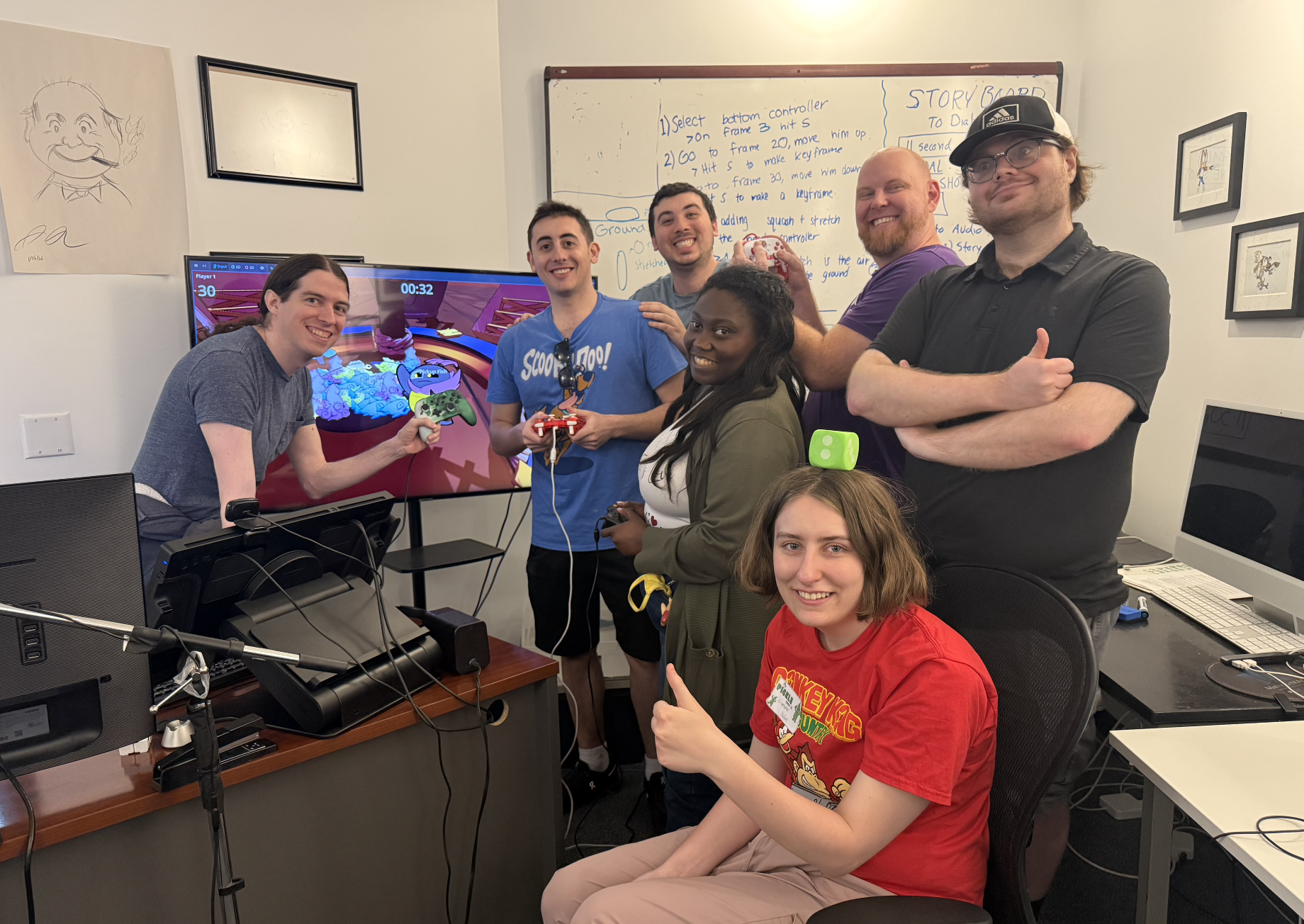
Start with a free virtual or on-campus tour
- The Full-Time Game Arts Program is a four-year commitment, with classes running weekdays
from 10:00 a.m. to 3:30 p.m. from September to June. - Full-Time students are 18 years of age or older with a high school diploma or G.E.D.
and must have an official medical diagnosis of autism. - While we work to place graduates of our Full-Time Programs in positions of employment both
internally and externally, Exceptional Minds does not guarantee employment to students or graduates at any time. - Annual tuition is $38,800.
- The fully remote option is available for $33,600.
- Needs based tuition assistance is available.
- Formal Diagnosis of Autism: Application requires submission of a letter of diagnosis and/or a recent IEP (Individualized Education Plan) stating diagnosis.
- Minimum educational level: Evidence of high school diploma or G.E.D.
- Independence: Applicants should demonstrate reasonable independence with transportation, hygiene, scheduling and punctuality, work completion, safety, money etc.
- Computer Fluency Skills: Applicants should demonstrate basic working knowledge of saving and naming files, Internet navigation and e-mails, and typing skills, etc.
- Executive Function: Applicants should demonstrate reasonable ability with independent planning, decision-making, time management, organization, etc.
- Ability to Follow Multi-step Directions: The ability to follow directions presented both orally and in writing.
- Basic Work-Related Social Skills: Listening, promptness, appropriate hygiene and dress, greetings and salutations, appropriate volume and tone, ability to work and learn in a group, and showing interest in coworkers, etc.
- Motivation: Taking pride in quality work, meeting deadlines, performing at or above the level of peers, able to work for periods without prompting or praise, etc.
Applying to Exceptional Minds’ Game Arts Program is a four step process. The steps are as follows:
1) Sign up and complete a tour online or in-person.
Click here for tour dates and times (You must complete a tour, in-person or online, before you can apply.)
2) Upload your application.
3) Upload your portfolio and additional requirements.
(You will receive information on how to complete this step after your application is submitted).
4) Complete a virtual assessment/interview.
(You will receive information on how to complete this step after your application is submitted).
- Understand how games are made – Learn the history, tools, and design principles that bring games to life.
- Adapt and solve problems – Use new tools, game engines, and methods to overcome creative and technical challenges.
- Create professional game assets – Make 2D and 3D art, animations, effects, and sound that work in real games.
- Build and test games – Use Unreal and Godot to design levels, worlds, and interactive prototypes.
- Work in production pipelines – Take on different roles, manage projects, meet deadlines, and collaborate with teammates.
- Use feedback to grow – Know when to ask for help, and use feedback from peers and mentors to make your work better.
- Communicate and collaborate – Share ideas clearly, listen actively, and work respectfully with others.
- Practice essential social skills – Manage time, stay organized, resolve conflicts, and respect personal boundaries in school and the workplace.
- Plan your career – Research jobs in games, build a portfolio and demo reel, network, and promote your work.
- Work independently and responsibly – Show you can meet professional standards with minimal supervision
First Year Fall:
History of Games / Interactive Entertainment 1 (1 period)
Game Art Production 1 (2 periods)
Game Engines 1 (2 periods)
Photoshop 1 (2 periods)
BaseCamp (1 period)
GameLab/Embark (2 periods) **Supervised work period.
First Year Winter:
History of Games / Interactive Entertainment 2 (1 period)
Game Design 1 (2 periods)
Narrative Design for Games 1 (2 periods)
Photoshop 2 (2 periods)
BaseCamp (1 period)
GameLab/Embark (2 periods) Supervised work period.
First Year Spring:
Game Design 2 (1 period)
Game Art Production 2 (2 periods)
Game Engines 2 (2 periods)
3D 1 (2 periods)
BaseCamp (1 period)
GameLab/Embark (2 periods) Supervised work period.
Second Year Fall:
Game Art Production 3 (3 periods)
Game Engines 3 (2 periods)
3D 2 (2 periods)
WorkSpace (1 period)
GameLab/Embark (2 periods) Supervised work period.
Second Year Winter:
World Building 1 (2 periods)
Game Art Production 4 (2 periods)
Sound Production 1 (1 period)
3D 3 (2 periods)
WorkSpace (1 period)
GameLab/Embark (2 periods) Supervised work period.
Second Year Spring:
Environment Production 1 (3 periods)
User Interface Design 1 (2 periods)
3D 4 (2 periods)
WorkSpace (1 period)
GameLab/Embark (2 periods) Supervised work period.
Third Year Fall:
Game Design 3 (2 periods)
Visual Effects for Games 1 (2 periods)
Game Art Production 5 (2 periods)
Portfolio (1 period)
GameLab/Embark (3 periods) Supervised work period.
Third Year Winter:
Environment Production 2 (2 periods)
Game Art Production 6 (2 periods)
User Interface Design 2 (2 periods)
Portfolio (1 period)
GameLab/Embark (3 periods) Supervised work period.
Third Year Spring:
Environment Production 3 (2 periods)
Game Design 4 (2 periods)
Visual Effects for Games 2 (2 periods)
Portfolio (1 period)
GameLab/Embark (3 periods) Supervised work period.
Fourth Year Fall:
Thesis 1 and/or Internship (7 periods)
Business Development for Games (1 period)
Production and Pipeline Management (1 period)
Career Readiness Seminar (1 period)
Fourth Year Winter:
Thesis 2 and/or Internship (7 periods)
Business Development for Games (1 period)
Production and Pipeline Management (1 period)
Publishing Your Game (1 period)
Fourth Year Spring:
Business Development for Games (1 period)
Publishing Your Game (1 period)
Portfolio 4 (1 period)
Thesis 3 and/or Internship (7 periods)**
**As part of the Game Arts program, students are required to complete an experiential learning component during their fourth year. Gaining real-world, on-the-job experience through an internship is a powerful way to reinforce and apply the skills students develop in the classroom.
Supportive Learning Environment
The Game Arts Program is intentionally designed to support young adults on the autism spectrum. In addition to technical training, students receive structured support in workplace-ready soft skills.
Embedded throughout the curriculum and project work are opportunities to practice:
Time management and organization
Communication and collaboration
Problem-solving
Giving and receiving feedback
Documenting creative ideas and production processes
To support student success, behavioral wellness staff are onsite to assist students with a wide range of individual needs.