
For a young artist, the years after high school lack a bridge to the professional workplace. Where the artist’s talent takes them can depend on the environment around them. Will this be a place the artist lands with only the promise of a lengthy professional career or a space of true longevity? Exceptional Minds gives its students and artists a solid bridge with specialized training, a professional portfolio, and a route into a creative career. What they build reaches past the craft, and most come away with the workplace habits of organization, responsibility, and professional expectations that turn talent into a solid profession.
How does Exceptional Minds support the transition to adulthood?
By treating this as a whole journey through these formidable years, most of EM’s students report developing workplace skills like organization, responsibility, and professional expectations, the habits that turn a talented young person into a working professional (EM Pulse Student Survey, 2026). Alongside the technical training, students grow in confidence, independence, and the practical readiness that adult life demands.
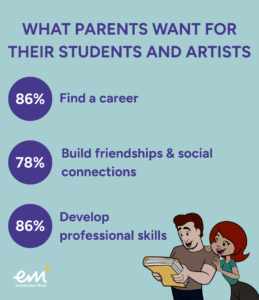
Families of the students and artists feel this. When we asked parents why they chose Exceptional Minds, their goals reached well past a single outcome: finding a job or career (86%), developing professional skills (86%), building friendships and social connections (78%), gaining confidence (75%), and learning to navigate workplace and adult responsibilities (67%) (EM Pulse Parent/Guardian Survey, 2026). 75% of parents rank the technical and artistic training in animation, VFX, game arts, and media production among the most helpful forms of work-readiness support their student has received.
One parent described the decision in their own words. “The main reasons for choosing Exceptional Minds were to offer our student time to mature, develop a solid sense of community, and receive support and experience while transitioning into a career.”
Why does a specialized path matter?
A specialized path matters because the right environment shapes where an artist ends up. Research on autistic young adults shows that those with postsecondary education experience higher employment rates, work more hours, and earn higher wages than those with less education (Whittenburg et al., 2019). Education after high school is one of the clearest pathways into employment and independence, and the environment where that education happens matters a great deal. A specialized, craft-focused studio built for how our students learn is designed to help them carry that education all the way into a career.
Paths like this have always been a critical necessity. Approximately 1.2 million autistic youth are expected to reach adulthood over the next decade (Roux et al., 2024). More than 5.4 million U.S. adults, roughly 1 in 45, are on the autism spectrum (Dietz et al., 2020). A large and rising number of talent are looking for exactly the kind of bridge into creative careers that Exceptional Minds was built to provide.
What families gain along the way
Unlocking innovation, elevating productivity and empowering cognitively diverse talent is exactly what families acquire with Exceptional Minds training and oversight. One current student described what that felt like. “The biggest thing Exceptional Minds has given me is a sense of independence and confidence, all thanks to the incredible support from the staff and instructors. Their mentorship helped me grow my technical skills as an artist, and they’ve truly helped me grow as a person, giving me the confidence to believe in myself both inside and outside the studio.”
The transition is working
Exceptional Minds students have crossed the bridge. They move from high school into specialized training, a professional portfolio, and inroads to a creative career. A parent does not have to hope those years will find a direction. A funder does not have to take the model on faith. The students crossing it now are the proof.
Frequently asked questions
What happens to autistic students after high school?
Many of the services that support autistic students during high school change after graduation, which makes the years that follow a critical time to build skills and direction. Exceptional Minds gives autistic young artists a specialized path into creative careers, with 66% of students reporting growth in workplace skills like organization, responsibility, and professional expectations (EM Pulse Student Survey, 2026).
Is Exceptional Minds an alternative to college for autistic artists?
Exceptional Minds offers specialized, career-focused training in animation, VFX, game arts, and media production. Because postsecondary education is linked to higher employment rates, more hours worked, and higher wages for autistic young adults (Whittenburg et al., 2019), a craft-focused program built for how our students learn can be a strong pathway into the creative industries.
What do parents hope their students gain at Exceptional Minds?
Parents’ goals include a job or career (86%), professional skills (86%), friendships and social connections (78%), confidence (75%), and the ability to navigate workplace and adult responsibilities (67%) (EM Pulse Parent/Guardian Survey, 2026).
Talk through next steps for your artist and the full time programs we offer at Exceptional Minds.