
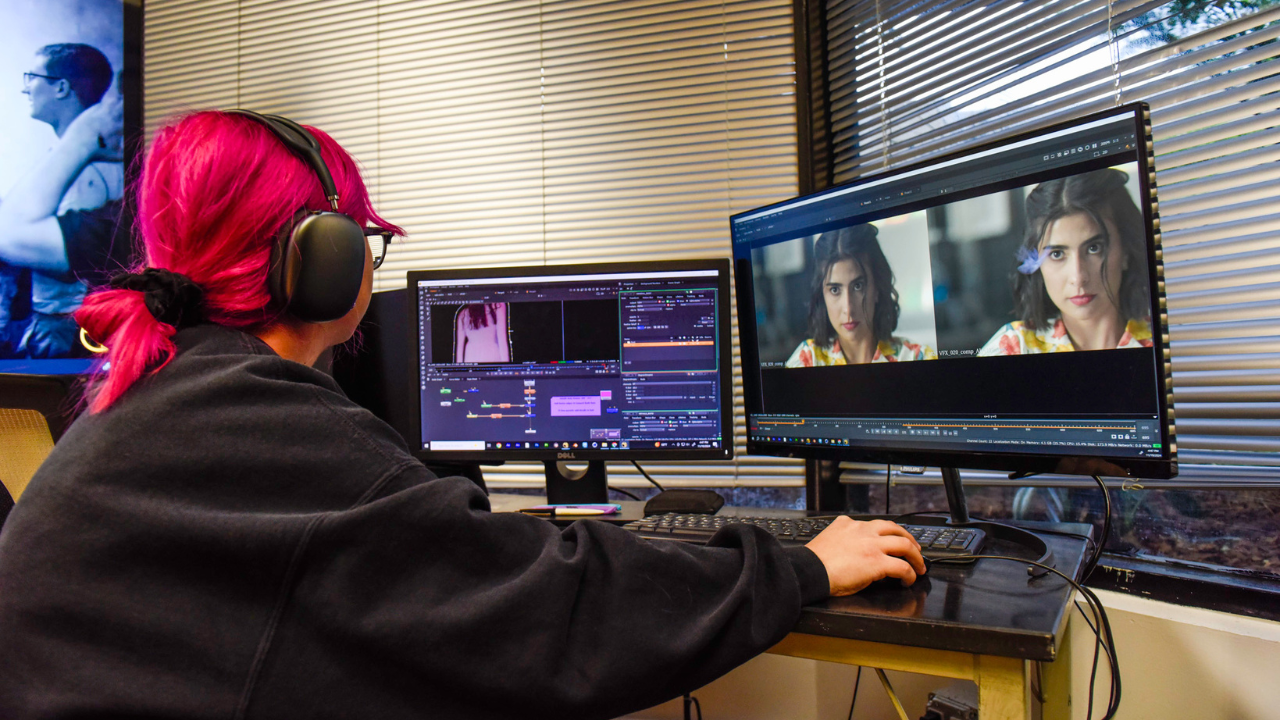
The Media Arts Foundation program is designed for those who are new to post-secondary education and media arts or those with limited experience who want to enhance their portfolio and related skills for further success studying or working.
With technical courses committed to the intersection of media-making and technology, this is a program that builds entry level media generalists and creative assistants. Curriculum areas of focus include: design, storytelling, media creation, professional practice, and work integrated learning.
In addition to mastering digital tools and related technology, the program aims to improve the students’ executive function, social and emotional well being with programming that finds a meaningful balance between whole-person development and academics. This balance between academics and soft skills is critical for student success and is supported by a student services group that includes a behavioral team and career advancement manager.
Pathways for students in the Media Arts Foundation include Exceptional Minds’ three year Animation/VFX program, other college media art offerings and apprenticeship programs. Outside of academic pathways, graduates may pursue entry level creative generalist and creative PA (production assistant) work in entertainment and media and adjacent industries or entrepreneurial pursuits.
View the full Course Catalog here
Trimester 1:
MAF 101 Work-Life Skills 1
Beginning with essential life and adulting skills, this course delves into the challenges and skills required for students’ transitioning into independent living and studying in a post-secondary setting. Course work weaves into the technical courses and aims to improve the students’ executive function, social and emotional well being with a curriculum that finds a meaningful balance between professional expectations, personal experience, and abilities.
MAF 102 – Storytelling with Words and Pictures
The best way to understand a story is to understand and tell your own. Part screenwriting, video editing and part media studies, this writing, creating, and reading course asks students to consider the dramatic structure of not only the shows they watch, the games they play but also the lives they lead and the activities of others. Students will use Adobe Premiere pro editing software.
MAF 103 – Design & Digital Tools 1
An introduction to design, color, and digital platform fundamentals, students in this course create digital content with the Adobe Creative suite and other relevant software and technologies. In addition to learning the techniques of digital tools, this project based class will explore the latest in image making technologies used by the entertainment and media industries.
MAF 104 – Drawing + Animation
Put charcoal and pencil to paper and start drawing! And then animate! A course that bobs and weaves between the digital world of Adobe Animate animation software and the fundamentals of drawing, this course provides a solid start to creating 2D animations.
This introductory course uses the 12 Principles of Animation and cinematic techniques for visual storytelling to develop students’ artistic and storytelling skills. Work will also focus on the development of positive professional habits including note-taking, organization, and presenting work, as well as performing various aspects of the animation production process and pipeline. (The drawing component hones students’ and observational skills and helps build aesthetic sensibilities, concentration and portfolios.)
Trimester 2
MAF 201 – Work-Life Skills 2
A continuation of Work-life Skills 1, this is a course designed to reach beyond topics of work and academic success explored in the first semester. Students explore meditation, yoga, exercise, nutrition, and other mindful and health forward pursuits. Its unique structure is weaved into the weekly schedule so that the student’s salutary activities become routine.
MAF 202 – Media Business Communication and Writing (Professional Skills)
Interview skills, networking, resume writing, and email communication are just a few of the competences needed to transition into the working world. In this course, students practice and deliver the fundamentals of workforce transition activities.
MAF 203 – Digital Tools 2: Motion Graphics
Students will use After Effects to combine their knowledge of Graphic Design with the 12 Principles of Animation to create engaging animations.
MAF 204 – Digital Tools 3: Intro to 3D
Paperman, Into the Spiderverse, and The Wild Robot all push the medium of 3D Animation and blend visual aesthetics associated with hand drawn animation. This course demystifies the discipline of 3D art and animation by providing an engaging tour of Blender. Students unfamiliar with 3D will discover the joy of this tool. Blender has been used in the industry by Sony for VFX, CD Projekt Red for modeling, and created the Oscar award winning film Flow (2024)
Trimester 3
MAF 301 – Work-life Skills 3
A continuation of Work-life Skills 1 and 2, this is a course designed to teach students about the different situations and responsibilities they may encounter in the workplace and related functions. The course also introduces basic spreadsheet and presentation creation tasks so students are equipped with the skills to succeed in different dynamic environments.
MAF - 302 Work-Integrated Learning or MAF 303 – Portfolio Project/Mentorship
Students complete a work placement– paid or unpaid– of at least 80 hours. Comprising up to two days per week of entry level work in a creative industry based organization, the placement runs in parallel with the Professional Practice course giving students and their employers persistent support in their pursuit. Weekly reflection and assessment prepares the students for further workforce transition or study.
Students may elect to develop a project for their portfolio in lieu of a work placement with a mentor. In this self-directed creative project, students build a portfolio piece on a platform of their choice in animation, motion graphics, editing, VFX, or writing.
MAF 304 – Digital Tools 4: Intermediate 3D
Students continue their exploration of 3D software to create work of greater complexity and completion. Beyond modeling, students will learn how to create 3D animation applying the principles of animation learned in previous classes. This course will also provide an introduction to game engine software, leading students to understand how 3D is applied in various ways to different areas of the digital arts.
MAF 305 - AI and Visual Effects
This course is an exploration into emerging tools and technologies in our modern media arts environment. Students utilize GenerativeAI tools such as Runway ML to create and manipulate video. In their journey they will also learn about the basics of visual effects such as tracking and rotoscoping, applying AI to existing frameworks for new creative expression.
Applying to Exceptional Minds’ Media Arts Program is a four step process:
1) Sign up and complete a tour online or in-person. You must complete this step before applying to the program.
2) Upload your application to attend Exceptional Minds.
3) Upload your portfolio and additional requirements.
4) Complete a virtual assessment/interview.